Home
Home
 About Us


Durian exporting businesses adapt to the digital age.
13/05/2026 10:58
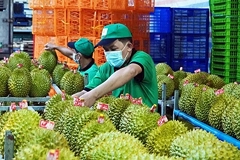
Durian exporting businesses adapt to the digital age.
According to Mr. Dang Phuc Nguyen, General Secretary of the Viet Nam Fruit and Vegetable Association (Vinafruit), in order to adapt to the digital era, from July 1, 2026, durian exporting businesses need to shift to a supply chain linkage mindset and modern management.
Durian businesses must shift from "collecting goods" to supply chain linkages.
From July 1st, 2026, the traceability system for durian will be officially implemented nationwide, marking a significant shift in the management of Viet Nam's multi-billion dollar export industry. In the context of increasingly stringent requirements from importing markets regarding quality, food safety, and supply chain transparency, the application of traceability is expected to enhance reputation, reduce trade fraud, and guide the durian industry towards more sustainable development. However, the implementation process also presents numerous challenges for businesses, cooperatives, and growers.
Speaking with a reporter from the Industry and Trade Newspaper, Mr. Dang Phuc Nguyen, General Secretary of the Viet Nam Fruit and Vegetable Association, said that to adapt to the "digital era" of the durian industry after July 1, 2026, businesses cannot continue to rely on traditional procurement models, but need to quickly shift to a chain linkage mindset and modern management.
“In the context of China and many high-end markets such as the EU, the US, and Japan continuously tightening technical and food safety standards, durian exporting businesses need to prioritize building a genuine ‘linked ecosystem’ with the raw material areas. Businesses must abandon the mindset of ‘only collecting goods when the season arrives’ and instead invest in the growing areas by sending technical staff to work alongside farmers and cooperatives; supporting them with fertilizers and pesticides that are on the permitted list; and strictly controlling the cultivation process,” shared the General Secretary of the Viet Nam Fruit and Vegetable Association.
Furthermore, signing quality-based supply contracts is considered a crucial solution to create a stable, transparent supply and meet traceability requirements. Incentive mechanisms for growing areas that meet GlobalGAP standards or effectively control cadmium residue will help businesses be more proactive in meeting the increasingly stringent requirements of import markets.
Besides linking raw material sources, businesses also need to accelerate the digitalization of management and packaging processes. Accordingly, a national traceability system is only a "necessary condition," while the "sufficient condition" is the technological capacity of the businesses themselves. Applying ERP in management, integrating data from procurement and transportation to preliminary processing, will help businesses retrieve records within minutes when importers request inspection.
In particular, investing in post-harvest technology such as cold storage and high-pressure air or water cleaning lines is a mandatory requirement to completely eliminate pests before packaging. This is also a common reason why many durian shipments have been returned or destroyed recently.
Promote deep processing and brand building to expand markets.
According to Mr. Dang Phuc Nguyen, in order to reduce dependence on a single market and mitigate risks when countries tighten import regulations, businesses need to proactively diversify durian products and export markets.
"Instead of focusing solely on exporting fresh durian, which faces significant pressure from plant quarantine and transportation time, businesses should prioritize investment in deeply processed products such as frozen durian, durian powder, or confectionery made from durian. This is considered a direction that helps increase value, extend shelf life, and expand access to the global market," Mr. Dang Phuc Nguyen recommended.
Simultaneously, the "green economy " trend is placing new demands on the agricultural sector. Markets like the EU are increasingly interested in carbon certification, production standards that do not cause deforestation, and sustainability in the supply chain. Businesses need to quickly access and apply these standards if they want to maintain a long-term competitive advantage.
Another important issue emphasized by Mr. Dang Phuc Nguyen is improving legal capacity and internal quality control. Businesses need to establish a specialized department to regularly update on international regulations such as Orders 248 and 249 of the Chinese market, or the SPS (Agreement on Sanitary and Phytosanitary Measures) and TBT (Agreement on Technical Barriers to Trade) regulations of the WTO to avoid risks in exports.
At the same time, an independent quality control department should be established with the authority to reject substandard shipments right at the packing warehouse, avoiding a situation where quantity is prioritized at the expense of brand reputation.
From a long-term perspective, businesses need to focus on building a brand rather than simply selling products under a label. Accordingly, using QR codes to tell the story of a product's journey from farm to table will help increase trust with international consumers. Furthermore, businesses should proactively register trademark protection in key markets to avoid the risk of misappropriation of geographical names (such as Ri6, Cái Mơn, etc.) or product trademarks.
Mr. Dang Phuc Nguyen believes that to adapt to the increasingly stringent requirements of the import market, businesses need to develop strategies for each specific stage. In the short term, it is necessary to review all the codes of the growing areas and packaging facilities currently in partnership to minimize the risk of sudden export suspensions. In the medium term, businesses need to accelerate the digitalization of their internal traceability systems to speed up customs clearance and reduce warehousing costs. In the long term, they need to invest heavily in freezing and deep processing technologies to reduce quarantine pressure and expand access to global markets.
“In the new context, honesty is the cheapest competitive advantage. Strictly adhering to the traceability system from July 1, 2026, may slightly increase operating costs in the short term, but it will be the best insurance for the survival of businesses in the international market,” Mr. Dang Phuc Nguyen emphasized.
Source: Vietnam.vn
Các tin khác
- U.S. to Impose Duties on Mexican, Thai, Vietnamese Chassis (03/06/2026)
- Mexican sugar producers push to scrap U.S. import quotas (03/06/2026)
- Japan launched an anti-dumping investigation into flat steel imports from three countries (03/06/2026)
- Eurochem challenges anti-dumping duties in the EU (03/06/2026)
- Pangasius prices in Viet Nam surge due to high export demand (03/06/2026)