Home
Home
 About Us


Complainant Withdraws Petition in EU Anti-Dumping Investigation on PET from Viet Nam
11/05/2026 04:36
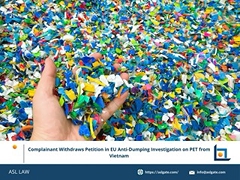
On May 1, 2026, the law firm O’Connor & Company – representing PET Europe, the complainant in the European Union (EU) anti-dumping investigation concerning certain polyethylene terephthalate (PET) products originating from Viet Nam – officially submitted a notice to the European Commission (EC) withdrawing the complaint originally filed on April 9, 2025.
This development is considered a noteworthy event in the trade remedy case involving Viet Nam’s plastics industry after nearly one year since the investigation was initiated. Previously, on May 22, 2025, the EC issued a notice initiating an anti-dumping investigation into certain PET products with a viscosity of 78 ml/g or higher according to ISO 1628-5 standards, currently classified under CN code 39076100, imported from Viet Nam into the EU market.
During the investigation process, many Vietnamese enterprises were required to respond to questionnaires, provide production and export data, and cooperate with the EU investigating authority in order to demonstrate that their export activities did not cause material injury to the European domestic industry.
On December 19, 2025, the EC published its preliminary findings and decided not to impose provisional anti-dumping measures on the investigated products. This was viewed as a positive signal for Vietnamese PET exporters, particularly as the EU remains one of the key export markets for Viet Nam’s plastics industry.
However, the complainant’s withdrawal of the petition does not automatically mean that the case has officially terminated. Under EU regulations, after receiving a withdrawal request, the EC must still assess whether maintaining the investigation would continue to serve the interests of the European Union before issuing a final decision. This means that the possibility of the investigation continuing from a legal perspective has not been entirely excluded.
In practice, within EU trade remedy proceedings, the investigating authority may still continue the case if it determines that sufficient evidence exists regarding injury or threat of injury to the domestic industry. Therefore, the relevant Vietnamese enterprises should not become complacent regarding the current development, especially since the EC’s final determination has not yet been issued.
For Vietnamese manufacturers and exporters of PET products, this case further demonstrates the growing trend of increased use of trade remedy measures in major export markets to protect domestic industries. If enterprises fail to closely monitor developments or do not adequately prepare data and supporting documentation, they may face disadvantages should the investigating authority request additional information or resume further procedural steps.
Apart from the direct impact on export activities, anti-dumping investigations may also affect commercial reputation, supply chains, and the ability to maintain customers in foreign markets. In many cases, merely being subject to an investigation can make import partners more cautious in conducting transactions or encourage them to shift to alternative suppliers in order to minimize risks.
In this context, the relevant Vietnamese enterprises should continue coordinating with competent authorities, proactively monitor updates from the EU side, and review export data as well as internal records in order to remain prepared for any additional requests or developments during the next stage of the proceeding.
To protect their legitimate interests, manufacturers and exporters should familiarize themselves with the procedure and actively contact Viet Nam Antidumping Law Firm specializing in anti-dumping and trade remedy for timely assistance.
Source: ASLGate
Các tin khác
- U.S. to Impose Duties on Mexican, Thai, Vietnamese Chassis (03/06/2026)
- Mexican sugar producers push to scrap U.S. import quotas (03/06/2026)
- Japan launched an anti-dumping investigation into flat steel imports from three countries (03/06/2026)
- Eurochem challenges anti-dumping duties in the EU (03/06/2026)
- Pangasius prices in Viet Nam surge due to high export demand (03/06/2026)