Home
Home
 About Us



China's Exporters Face Challenges
26/03/2009 12:00
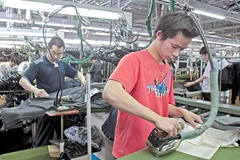
As our reporter DD investigates how more and more Chinese exports are facing frictions, let's take a look what can be done to reduce some of these challenges.
Confronted by the most serious economic downturn in decades, China is grappling with a series of intractable issues ranging from how to revive its weak domestic demands, to how to create more jobs for tens of, if not hundreds of millions of laid off workers and new university graduates. But for a country whose economic growth is powered by trade, the export industry is on the forefront to feel the economic pinch. As our reporter DD investigates how more and more Chinese exports are facing frictions, let's take a look what can be done to reduce some of these challenges.
Reporter:
Yingyou Group is among China's largest producers of textile machinery based out of east China's Jiangsu province. Orders from overseas markets began to drop late last year. As chairman of the company, Zhang Guoliang says he understands the difficulty his overseas partners are facing in light of economic uncertainties, but what he cannot understand is why Yingyou's products are facing penalties for irrelevant charges in many target markets.
"Upon arrival, many of our local clients refused to pick up the goods by filing complaints to the local authorities. As a consequence of that, Customs detained all shipment. We think these complaints are very unreasonable and unjustified. As a matter of fact, we are not the only company to be under investigation. Many Chinese companies are running the same risk of losing profits by interference from such non-market factors."
In many cases, Zhang says, importers refused to show up in ports on schedule for this one reason or another, and Customs will not confiscate them or allow exporters to transfer their products back to its departure country. As a consequence, Chinese enterprises have to pay high port fees for stockpiles, and eventually abandon them for increasing costs. The incidents always end up auctioned by Customs.
Zhang Guoliang told CRI in recent years, textile industry has suffered the effects of an appreciating currency, soaring production costs, and many other fluctuations, but none of them are inflicted by the actions of a single country.
Zhang believes trade protectionism is behind the move, and he worries that as more countries take similar steps in name of protecting domestic industries, Chinese products will face more trouble in the international market.
"To ensure timely and proper goods delivery, we now carefully prepare documents for Customs clearance, many of which may not be necessary in the past. So once problems occur, we will show our proof as quickly as possible, and in some case, we will take legal action to bring justice."
In recent years, with the increasing competitiveness of made-in-China products and larger shares in the international market, China is running into more frictions with its trading partners. Information from related government agencies shows, over 11 consecutive years China has been the country with the largest number of dumping charges with annual losses of some 30 billion to 40 billion US dollars.
At a time when the world's major economies slide into recession, China is now again becoming the target of trade wars. The US, the European Union, among many others have recently begun to levy anti-dumping taxes on steel, machinery parts and tyre imported from China, and some even put a ban on imports from China.
Except anti-dumping charges, more and more countries are imposing higher technical standards to limit Chinese exports. India, for example, has banned Chinese toy imports for six months in January, but later allowed such imports provided they were accompanied by quality certificates from internationally recognized laboratories and agencies.
To withstand fiercer competition, many Chinese companies are raising their threshold on product quality.
Longda Group in eastern Shangdong province is a large food processing company. Its major market is Japan. Its president Gong Xuebin told reporters in order to meet high food safety standards in Japan, his company has had to enforce a stricter testing system to improve food safety.
"Back in 2005, we sent a group of three technical professionals to study in Japan, to get to know their market requirement, esp. in regard to product safety. We spent more than 20 million yuan to import processing facilities tailored to the Japanese market."
Gong says because his company has been strictly following the Japanese standards, his products have gained strong brand awareness in the country. He estimates the company's export to Japan will grow steadily this year despite the overall decline in China' export there.
Zhang Xiaoji, an economist with the Development Research Center of the State Council, China's major think-tank, warns China must be cautious about trade protectionism, and aware of it's potential dangers.
"If no actions are to be taken against rampant trade protectionism, it would not only affect the export sector, but the import sector. Many of China's exports are processed based on imported materials, equipment and technology, so it is not only China as an exporter but all countries that will be affected by trade protectionism. In this sense, it's a disaster to the whole global trading system and therefore global reaction needs to be in place to respond to discriminative measures."
Chai Xinjian, general manager of Little Swan Group, a manufacturer of home appliances suggests that bringing discriminative actions to the World Trade Organization may be one option to help Chinese enterprises escape unfair treatment.
"Under the WTO framework, all sides should play the game by the WTO rules. A unilateral action is against the will of the global trading body, so it can be the platform for Chinese enterprises seek justice and regain their market shares."
For Biz China, I'm DD.
CRIENGLISH.com
Web Editor: Cao Jie
2009-03-24 11:32:50
Source: english.cri.cn
Các tin khác
- Rising global shipping costs put pressure on Viet Nam’s seafood exporters (22/06/2026)
- India likely to retain anti-dumping duties on Bangladeshi jute products (22/06/2026)
- Japan slaps anti-dumping duties on Chinese, Taiwanese steel (22/06/2026)
- India initiates anti-dumping probe against a Chinese, Japanese chemical used in tyre, rubber items (22/06/2026)
- Reasons why the US continues to suspend customs clearance for Vietnamese trailers (22/06/2026)