Home
Home
 About Us



China steel mills post losses of $1.8 billion for Jan-Feb: CISA
12/04/2016 12:00
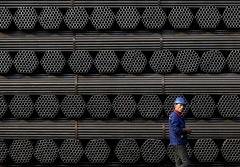
China's major steel mills have made combined losses of 11.4 billion yuan ($1.8 billion) for the first two months of this year as chronic oversupply weighed on the sector, an official with the China Iron & Steel Association (CISA) said on Thursday.
The steel sector, struggling with a persistent supply glut, slowing demand and decades-low prices, lost more than 100 billion yuan in total from its core business last year, 24 times the losses made in 2014, according to remarks by CISA secretary general Liu Zhenjiang published on the association's website.
Chinese steel exports are very likely to fall this year as a result of rising anti-dumping complaints and trade protectionism from other countries, after surging to a record 112 million tonnes last year, Liu also said.
Liu described the sector's performance in 2015 as the worst ever, mainly due to losses in the second half of the year that accumulated at a rate of 10 billion yuan a month.
"The situation in 2015 cannot be sustained into 2016, and the sector must carry out multiple measures to boost its returns," Liu said.
A pick-up in restocking demand in 2016 has revived hopes that the sector would rebound, and CISA's composite price index has gained more than a fifth since the beginning of the year. At 69.81, though, the index remains some 30 percent lower than the reference price set in 1994.
Spot iron ore prices have also gained nearly a quarter since the end of 2015, but have fallen back 15 percent from the high for the year so far, hit in early March, with big foreign miners increasing deliveries to China.
Chinese iron ore inventories at ports surpassed 100 million tonnes on Thursday, according to industry data, fuelling expectations that prices of the raw material will come under renewed pressure.
Iron ore inventories at 42 big ports reached 100.2 million tonnes, up 265,000 tonnes from the previous day, data from industry consultancy Umetal.com showed.
"The figure definitely has an impact on market sentiment, and we are expecting more downside risks for iron ore as demand from steel mills remains weak while supplies keep rising," said Zhao Chaoyue, an analyst with Merchant Futures in Shenzhen.
"Steel mills are resuming production at a very slow pace, suggesting they are still worried about the long-term demand outlook," Zhao said.
The steel sector, struggling with a persistent supply glut, slowing demand and decades-low prices, lost more than 100 billion yuan in total from its core business last year, 24 times the losses made in 2014, according to remarks by CISA secretary general Liu Zhenjiang published on the association's website.
Chinese steel exports are very likely to fall this year as a result of rising anti-dumping complaints and trade protectionism from other countries, after surging to a record 112 million tonnes last year, Liu also said.
Liu described the sector's performance in 2015 as the worst ever, mainly due to losses in the second half of the year that accumulated at a rate of 10 billion yuan a month.
"The situation in 2015 cannot be sustained into 2016, and the sector must carry out multiple measures to boost its returns," Liu said.
A pick-up in restocking demand in 2016 has revived hopes that the sector would rebound, and CISA's composite price index has gained more than a fifth since the beginning of the year. At 69.81, though, the index remains some 30 percent lower than the reference price set in 1994.
Spot iron ore prices have also gained nearly a quarter since the end of 2015, but have fallen back 15 percent from the high for the year so far, hit in early March, with big foreign miners increasing deliveries to China.
Chinese iron ore inventories at ports surpassed 100 million tonnes on Thursday, according to industry data, fuelling expectations that prices of the raw material will come under renewed pressure.
Iron ore inventories at 42 big ports reached 100.2 million tonnes, up 265,000 tonnes from the previous day, data from industry consultancy Umetal.com showed.
"The figure definitely has an impact on market sentiment, and we are expecting more downside risks for iron ore as demand from steel mills remains weak while supplies keep rising," said Zhao Chaoyue, an analyst with Merchant Futures in Shenzhen.
"Steel mills are resuming production at a very slow pace, suggesting they are still worried about the long-term demand outlook," Zhao said.
Source: Reuters
Các tin khác
- New-generation FTAs open wider export opportunities to Middle East and South Asia (15/06/2026)
- Updated regulations on foreign trade management and import quotas (15/06/2026)
- Mandatory traceability for high-risk goods from July 1st: What should businesses prepare for? (15/06/2026)
- Tariff pressure is forcing businesses to restructure in order to adapt. (15/06/2026)
- Coffee Citizens model aims to lift Vietnamese value chain (15/06/2026)