Home
Home
 About Us


Can Vietnam redefine the future of cross-border e-commerce?
19/05/2025 05:30
The country’s value chain is evolving fast – integrating supply, logistics and consumer-facing operations
Global e-commerce is undergoing a seismic shift, driven by the rise of cross-border business. What was once dominated by traditional supply chains has now evolved into a globally connected trade system, where sellers can reach international consumers directly.
China has long been the powerhouse of this space, but emerging players in South-east Asia, such as Vietnam, are becoming serious contenders. With competitive manufacturing costs, strategic trade agreements, and increasing foreign activities and investments, Vietnam is seemingly well-positioned to capitalise on the shifting dynamics of global commerce. The big question now is: How will Vietnam challenge China’s dominance and redefine the future of cross-border e-commerce
We have seen how modern direct-to-consumer brands have scaled their playbook: sourcing from overseas, branding locally, and selling directly to end-consumers domestically. These are classic examples where many brands leverage China’s or Vietnam’s competitive edge in manufacturing (to keep prices low) and utilise brand premium to optimise selling prices.
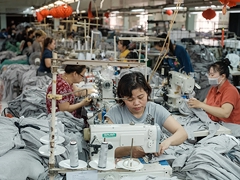
Such dynamics are typically powered by decade-long industrialisation and country specialisation, which have defined manufacturing lanes for specific categories. For example, Vietnam is strong in apparel manufacturing, from simple to complex wear, such as suits. In parallel, global logistics has also undergone a decade-long period of improvement and optimisation, which has reinvigorated the current wave of cross-border e-commerce.
Consider the example of Amazon. On Amazon, you can buy almost everything and get it delivered to you in a couple of days. Not only has e-commerce delivery speed improved considerably, but the range of the product catalogue has also expanded. Unbeknownst to many, the vast majority of all products sold on Amazon US are made in China, and nearly half of Amazon US’ top sellers are China-based, many of which operate from China and some without any physical presence in the US.
From “Made in China” to “Sold by Chinese”
Cross-border e-commerce enables sellers to leverage domestic supply chains to sell directly to international markets. Chinese sellers were the pioneers of this movement and essentially fully mastered the craft. Just last year alone, about 40 per cent of global cross-border e-commerce purchases originated from China.
The first movement originated from the “Made in China” phase, where retailers went to China to outsource cheaper manufacturing processes. Now, in a “Sold by Chinese” movement, Chinese sellers are developing direct branding and retail capabilities to sell directly to consumers on global platforms such as Amazon, instead of acting as third-party suppliers to Western brands.
This goes beyond just cheaper goods: it was about mastering the approach to e-commerce, building a standalone brand identity, and owning the full customer journey. Over time, these sellers have fine-tuned their sophisticated strategies with specific keyword targeting and optimised listings with multiple tactics. Some even adopt Western-centric branding to appeal to US consumers.
The gradual acceptance of Chinese brands perhaps reflects a maturing of customer perception, moving beyond the common fallacy of “cheap, low-quality Chinese products”.
Source: The Business Times
Các tin khác
- U.S. to Impose Duties on Mexican, Thai, Vietnamese Chassis (03/06/2026)
- Mexican sugar producers push to scrap U.S. import quotas (03/06/2026)
- Japan launched an anti-dumping investigation into flat steel imports from three countries (03/06/2026)
- Eurochem challenges anti-dumping duties in the EU (03/06/2026)
- Pangasius prices in Viet Nam surge due to high export demand (03/06/2026)