Home
Home
 About Us



Can joint ventures fix China’s trade imbalance with the EU and US?
14/10/2024 04:50
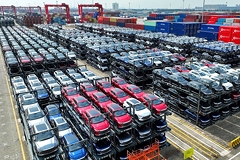
Chinese investment abroad is ‘only way’ to ease Beijing’s trade surplus, says leading researcher in wake of Brussels’ EV tariff vote
Encouraging Chinese companies to set up joint ventures abroad may be Beijing’s only way out of its trade imbalances with Western countries, according to a Chinese foreign trade expert.
Speaking at a round table event in Beijing on Friday, Huo Jianguo, former head of a think tank under China’s Ministry of Commerce, told representatives of foreign embassies and international organisations that he was “worried about [China’s trade] surplus”.
He said one way to mitigate the problem would be to foster more joint ventures, which pool the resources of Chinese and foreign entities for a shared business or project.
“If there are more joint ventures or more investment [into these countries], on the whole, they will feel better because [they will think that although] we have a deficit, we have new investment, so that will make a little bit of balance,” said Huo, former president of the Chinese Academy of International Trade and Economic Cooperation.
While Beijing must maintain “friendly dialogue” with its trading partners about the trade balance, China should also open up more and “stimulate companies to invest abroad”, Huo said.
“That’s the only way to solve this problem,” he said in the round table event hosted by the Beijing-based Centre for China and Globalisation, a non-governmental think tank.
The round table came as Western countries continued to blame China for trade imbalances, accusing it of exporting its industrial capacity amid weak domestic demand since 2021, especially in the electric vehicle sector.
Trade tensions are growing, with China announcing on Tuesday that it will start collecting anti-dumping duties on European brandy. The announcement came just days after Brussels voted to impose tariffs on Chinese-made EVs after concluding that Beijing was unfairly subsidising EV exports to Europe.
The long-standing EU trade deficit with China reached a record €396 billion (US$433 billion) in 2022. The figure fell to €292 billion last year, but Brussels said there were “imbalances that remain significant” and “a matter of great concern”.
The European Union has also raised concerns about foreign direct investment in its member states. In January, the bloc proposed plans to review its vetting mechanism for foreign investment and impose tighter controls on technology outflows.
But Huo said the EU market was “so big” that China could not give up on it, even though its trade relations with the emerging economies of the Global South were growing.
“If we want China’s foreign trade [to be] stable, we need to continue to explore or stabilise the shares of the American market and the EU market,” he said, adding that it was important as “domestic investment and consumption is weak”.
Yi Xiaozhun, former deputy director of the World Trade Organization and another speaker at the event, said Beijing should do more to increase consumption in China.
He added that Chinese exports were strong not because of subsidies or protectionist policies but because of the country’s integration into the global value chain.
“I think it’s definitely not China’s goal to pursue [a high] trade surplus,” Yi said.
“It’s high time for China and its trading partners to talk about it. As long as it’s a trade issue, we have WTO rules, we have common interest to address this kind of imbalance.
“So we need to have this kind of discussion instead of [waging a] trade war or geopolitical struggle.”
Source: SCMP
Các tin khác
- U.S. to Impose Duties on Mexican, Thai, Vietnamese Chassis (03/06/2026)
- Mexican sugar producers push to scrap U.S. import quotas (03/06/2026)
- Japan launched an anti-dumping investigation into flat steel imports from three countries (03/06/2026)
- Eurochem challenges anti-dumping duties in the EU (03/06/2026)
- Pangasius prices in Viet Nam surge due to high export demand (03/06/2026)