Home
Home
 About Us



Bee conference addresses 'funny honey'
16/12/2008 12:00
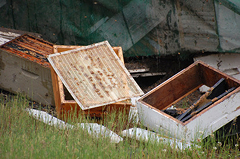
There's a buzz by the Falls this week.
And it's not from the slot machines at Fallsview, but rather from the Hilton across the street where beekeepers from across the country have swarmed for their annual convention.
Over 250 people have gathered to spend the next few days reviewing the latest research on hive health along with new uses for bees and their byproducts.Their sting may be painful, but bees are a vital part of the food system.
"One out of every three mouthfuls you eat depends on bees to pollinate that crop," Ontario Beekeepers Association spokeswoman Karen Davidson said.
It's why a good portion of this year's convention will be spent looking at what is causing a global drop in the bee population.
Figures from the association show that Canadian beekeepers lost 38 per cent of their bees over the 2006-07 winter and another 32 per cent last year.
"They've identified some of the stuff that may be causing the death, but we're having trouble adjusting to keep the bees alive," association president Don Walker said.
Like many beekeepers, Walker's is a family run apiary -or bee farm.
"We don't have as much of a profit as a big corporation to be able to treat our bees," Walker said.
That's why conferences like this one are so important to get the latest information out to all beekeepers.
Another factor threatening the honey business in Canada is the dumping of foreign honey in the U. S. market.
While there are anti-dumping tariffs on Chinese honey, it still makes its way through third-party countries.
Elise Gagnon is the president of Quebec- based Odem International, one of the largest honey import-export firms in Canada. She's had to take a closer look at the source of honey offered by foreign sellers.
"I was offered mysterious honey from a Malaysian source for 85 cents a pound," she said.
"How can you compete with that?"
The "funny honey" is not making its way into the Canadian market due to stringent testing by the Canadian Food Inspection Agency, Gagnon says.
Chinese honey does not meet the established quality standards due to the presence of antibiotic residues and the addition of other sweeteners to the product.
Still, the American market sets the price for Canadians, forcing beekeepers north of the border to lower their wholesale prices.
Some beekeepers are seeking out uses for bees beyond the traditional honey.
Ann Board from Restoule, just a short hop southwest of North Bay, use bees and their products medicinally. The field is called apitherapy and it's growing fast, Board says.
"Everything bees produce is healthy to humans," Board explains.
Even plain old beeswax works as a wonderful healer for cuts and bruises, according to Board.
Board, along with other beekeepers and honey producers, will be on hand through Saturday on the mezzanine level of the Fallsview Hilton as part of the convention.
Các tin khác
- Rising global shipping costs put pressure on Viet Nam’s seafood exporters (22/06/2026)
- India likely to retain anti-dumping duties on Bangladeshi jute products (22/06/2026)
- Japan slaps anti-dumping duties on Chinese, Taiwanese steel (22/06/2026)
- India initiates anti-dumping probe against a Chinese, Japanese chemical used in tyre, rubber items (22/06/2026)
- Reasons why the US continues to suspend customs clearance for Vietnamese trailers (22/06/2026)