Home
Home
 About Us



Adapting to export regulations to China
29/05/2026 05:03
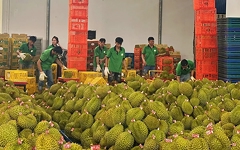
From June 1st, Legal Document No. 280 of the General Administration of Customs of China will take effect, changing many regulations related to the registration of export codes for food and agricultural products. The new regulations both create more favorable conditions for businesses undergoing significant digital transformation and impose stricter requirements on the accuracy and transparency of documentation. In response to these changes, agricultural export businesses are seeking ways to adapt and minimize the impact on their export processes.
The stacks of paperwork and the lengthy procedures for obtaining export codes for rice to China a few years ago remain an unforgettable memory for the business department of the Northern Food Corporation. However, with the new regulations from Decree 280, the automatic renewal of export codes not only helps businesses reduce concerns about export disruptions due to procedural delays, but also ensures that even if a company forgets to renew, the code will remain valid without affecting customs clearance.
But new things always come with challenges. For example, Saigon Spices Import-Export Company, after restricting access to the Middle Eastern market, is now looking to expand into the Chinese market. However, they are still unsure whether their products fall under the category of "self-registered but requiring a letter of recommendation from an authorized agency" or "self-registered without requiring a letter of recommendation from an authorized agency." The procedures for registering commodity codes also require more careful consideration.
Ms. Ho Thi Huong, Deputy Director of Saigon Spices Import-Export Company, stated: "In addition, businesses also face difficulties in preparing documents in English or Chinese according to the correct templates of the Chinese side, especially with content related to production process diagrams, food safety management systems, traceability, residue control, and pest control."
Furthermore, businesses often overlook the importance of accurate information declaration. The Chinese customs declaration system is fully automated, so even a small discrepancy between business licenses, labels, registration documents, or customs declarations can lead to customs clearance rejection.
Businesses also need to pay special attention to the validity of the registration number. For self-registered products, the registration number must still be valid at the time of import declaration. If the number has expired, the goods will not be allowed to clear customs.
Things to note when exporting agricultural products to China.
To guide businesses in complying with the regulations of importing countries, the Import-Export Department of the Ministry of Industry and Trade recently issued a notice on several points that businesses often encounter during the customs clearance process.
According to regulations related to Order 280, many food groups imported into China must register a business code along with a letter of introduction from the competent authority. The review is based on the level of food safety risk and any incidents that have occurred.
Currently, 17 out of 18 food groups fall under this category, with frozen fruits being the only exception. Additionally, business registration codes may not be automatically renewed if updates, manual verification, or product-related incidents occur at the national or regional level.
Opportunities for industry standardization to retain market share.
In addition to legal document No. 280, China is also continuously updating new requirements related to production facility registration, food safety control, animal and plant quarantine, labeling, packaging, and traceability.
If businesses do not proactively grasp new regulations, prepare complete documentation, meet production conditions, and establish quality control systems as required, the risk of export disruption is entirely possible. Overall, this is both a challenge and an opportunity for us to standardize our industries.
A long-standing practice among agricultural export businesses is to purchase from numerous farms through middlemen, then consolidate the goods into a single point of sale. If any shipment violates regulations, it becomes very difficult to trace the origin of the product. This will gradually change with China's new regulations. Businesses will be forced to establish close ties with farmers, have their own raw material sources, and adhere to a common production process.
Decree 280 applies stricter principles to risk management. This means increased post-inspection. Chinese customs can suspend imports if they discover that a business violates food safety regulations, has an inadequate food safety management system, is uncooperative with inspections, or has not completed corrective measures.
Your country will cancel the registration if a serious food safety incident occurs, serious violations during import inspections, provision of falsified documents, leasing or transferring the registration code, similar to the chaotic handling of planting area codes that has occurred in the past.
China is currently Vietnam's largest market for agricultural products, accounting for over 21% of total agricultural, forestry, and fisheries exports in the first four months of this year, an increase of nearly 30% compared to the same period last year. In particular, up to 90% of durian production depends on this market. Complying with Chinese regulations is not only a mandatory requirement to maintain market share but also an opportunity for Vietnamese agricultural products to upgrade their production chains towards modernization.
Source: Vietnam.vn
Các tin khác
- U.S. to Impose Duties on Mexican, Thai, Vietnamese Chassis (03/06/2026)
- Mexican sugar producers push to scrap U.S. import quotas (03/06/2026)
- Japan launched an anti-dumping investigation into flat steel imports from three countries (03/06/2026)
- Eurochem challenges anti-dumping duties in the EU (03/06/2026)
- Pangasius prices in Viet Nam surge due to high export demand (03/06/2026)