Home
Home
 About Us



Over 20 Vietnamese basa fish exporters withdraw from EU market
30/07/2021 05:24
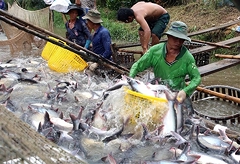
Nearly 25 Vietnamese enterprises exporting basa fish have withdrawn from the EU market since the beginning of the year.
The Việt Nam Association of Seafood Exporters and Producers (VASEP) said that Việt Nam's basa exports reached US$788 million in the first half of the year, a year-on-year increase of 18 per cent.
While exports to the US and small-scale markets are experiencing strong growth, exports to the EU are continuously decreasing. The total value of basa exports to the EU reached US$51 million as of last month, a year-on-year decrease of 21 per cent.
The export value of basa to the EU has declined for the past two years.
A representative of VASEP said that due to changes in the EU market, many basa exporters had turned to other markets. By the end of May, nearly 25 Vietnamese exporters had withdrawn from the EU market.
Talking to Tiền Phong (Vanguard) newspaper, Trương Đình Hòe, VASEP general secretary of the Việt Nam Association of Seafood Exporters and Producers, said that after the Việt Nam - EU Free Trade Agreement took effect, Vietnamese basa exports to this market enjoyed a preferential tax rate, down to only 0 per cent, opening up great opportunities for Việt Nam's basa industry.
In the EU, Việt Nam dominates the basa market and seems to have no competitors. Some countries like Bangladesh and China also export basa to the market, but the volume is lower.
Hòe said that entering this year, the retail market in the EU has begun to recover after a deep decline due to the impact of the coronavirus.
However, the food service industry, including restaurants and hotels in the EU, is recovering very slowly.
Meanwhile, importers are more cautious in their orders, especially since the outbreak of the coronavirus. EU consumers have started to change their consumption habits, and are more interested in safety, of which they were already very demanding.
Customers asked for higher quality products but offered lower prices. The requirements for food safety standards were very strict, and if the product was found to be non-compliant, it would be simultaneously reported and thoroughly inspected at the port of entry, he added.
This could take from two to three weeks, causing costs incurred to increase. EU customers are also increasingly demanding basa has a sustainability certification, according to Hòe.
Trần Đình Luận, director general of the Directorate of Fisheries under the Ministry of Agriculture and Rural Development, said that to improve the value of basa exports to the EU market, businesses needed to invest in and improve processing capacity to meet safety standards and strict conditions from the EU.
At the same time, businesses also needed to operate actively and flexibly, reduce costs during operation, and increase adaptability and competitiveness in the context that the market will change due to the impact of the pandemic, he added.
Source: Custom News
Các tin khác
- Viet Nam extends anti-dumping duties on some Thai sugar products to 2031 (05/06/2026)
- Hong Kong: Ministry of Commerce Rules on Inheritance of Anti-dumping Duty Rates for Copolymer Polyoxymethylene Imports Originating from S Korea, Thailand and Malaysia (05/06/2026)
- Early-season Vietnamese lychees conquer US consumers (05/06/2026)
- Global rubber prices surge, raising hopes for Vietnamese exporters (05/06/2026)
- Modern logistics creates new growth opportunities for Lang Son’s border-gate economy (05/06/2026)