Home
Home
 About Us



Garment exports to Eurasian Economic Union might have exceeded quota
22/03/2021 12:00
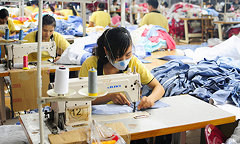
Some textile and garment items which are entitled to preferential tariffs in the Eurasian Economic Union under a bilateral free trade agreement exceeded the quota last year.
The Ministry of Industry and Trade said it recently received a diplomatic note from the Eurasian Economic Commission saying that while the quota for jerseys, pullovers, cardigans, and waistcoats was 1,520 tonnes a year, exporters had shipped over 1,640 tonnes. Exports of knitted women’s suits also exceeded the quota of 382.7 tonnes, with 414.9 tonnes being shipped.
The agreement incorporates safeguard measures against exceeding quotas, and accordingly Vietnamese textile-garment exporters will not be entitled to preferential tariffs for a period of six to nine months and instead will have to pay Most Favored Nation import duties.
But Pham Xuan Hong, chairman of Ho Chi Minh City Textile and Garment Association, told local media that members had not received any warnings from their partners in the EAEU market.
Nguyen Ly Truong An, deputy CEO of logistics firm SeaAir Global, said there are textile companies with factories in Vietnam who import products from China and pass them off as made in Vietnam, thus causing export volumes to surge.
"If strong measures are not taken to deal with the origin fraud, Vietnam’s textile and garment industry will be severely affected."
The Trade Remedies Authority of Vietnam announced a list of 13 other products also likely to face trade origin fraud or illegal transshipment investigations, including plywood made from hardwood, foam cushions and wooden cabinets exported to the U.S., and car tire exports to the U.S. and the EU.
The Ministry of Industry and Trade said it recently received a diplomatic note from the Eurasian Economic Commission saying that while the quota for jerseys, pullovers, cardigans, and waistcoats was 1,520 tonnes a year, exporters had shipped over 1,640 tonnes. Exports of knitted women’s suits also exceeded the quota of 382.7 tonnes, with 414.9 tonnes being shipped.
The agreement incorporates safeguard measures against exceeding quotas, and accordingly Vietnamese textile-garment exporters will not be entitled to preferential tariffs for a period of six to nine months and instead will have to pay Most Favored Nation import duties.
But Pham Xuan Hong, chairman of Ho Chi Minh City Textile and Garment Association, told local media that members had not received any warnings from their partners in the EAEU market.
Nguyen Ly Truong An, deputy CEO of logistics firm SeaAir Global, said there are textile companies with factories in Vietnam who import products from China and pass them off as made in Vietnam, thus causing export volumes to surge.
"If strong measures are not taken to deal with the origin fraud, Vietnam’s textile and garment industry will be severely affected."
The Trade Remedies Authority of Vietnam announced a list of 13 other products also likely to face trade origin fraud or illegal transshipment investigations, including plywood made from hardwood, foam cushions and wooden cabinets exported to the U.S., and car tire exports to the U.S. and the EU.
Source: VNExpress
Các tin khác
- Viet Nam extends anti-dumping duties on some Thai sugar products to 2031 (05/06/2026)
- Hong Kong: Ministry of Commerce Rules on Inheritance of Anti-dumping Duty Rates for Copolymer Polyoxymethylene Imports Originating from S Korea, Thailand and Malaysia (05/06/2026)
- Early-season Vietnamese lychees conquer US consumers (05/06/2026)
- Global rubber prices surge, raising hopes for Vietnamese exporters (05/06/2026)
- Modern logistics creates new growth opportunities for Lang Son’s border-gate economy (05/06/2026)